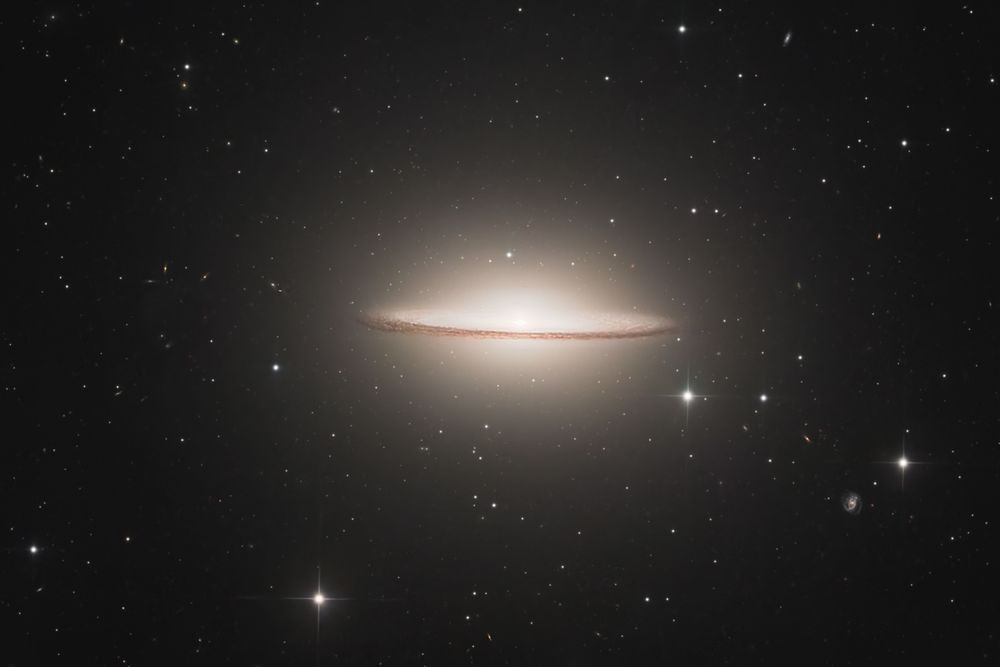
This is astrophotography — a photographic capture of Messier 104, commonly called the Sombrero Galaxy, seen edge-on in the constellation Virgo. The image highlights the pronounced central bulge and the thin, brownish dust lane that encircles the bright core. Careful framing places the galaxy slightly off-center, allowing the surrounding stars and faint background galaxies to provide context and scale while preserving a quiet, contemplative mood.
The Sombrero Galaxy is approximately 28–31 million light-years away and spans roughly 50,000 light-years across. Discovered by Pierre Méchain in 1781 and cataloged by Charles Messier, M104 is notable for its striking dust lane and a compact, bright nucleus. Astronomical measurements suggest a massive central black hole on the order of several hundred million to ~1 billion solar masses, which contributes to the intense core brightness visible in long-exposure imagery.
Printed from the original high-resolution capture, this piece preserves subtle gradients of halo light and the delicate texture of the dust lane. Several background galaxies are also visible. It’s suitable for science-minded collectors, interior designers, and anyone seeking a true photographic representation of the cosmos rather than a painting or digital illustration. The composition aims to evoke calm and curiosity: a reminder of the scale and quiet beauty of deep space.
Encyclopedic Data & Trivia
-
Common name: Sombrero Galaxy; catalog: Messier 104 (M104).
-
Constellation: Virgo.
-
Distance: ~28–31 million light-years.
-
Diameter: ~50,000 light-years.
-
Discovered by Pierre Méchain in 1781; cataloged by Charles Messier.
-
Central black hole estimated at several hundred million to ~1 billion solar masses.
-
Visual magnitude ~8.0, making it observable with modest amateur equipment under dark skies.
This is a photographic print (astrophotography), not a painting or digital illustration.