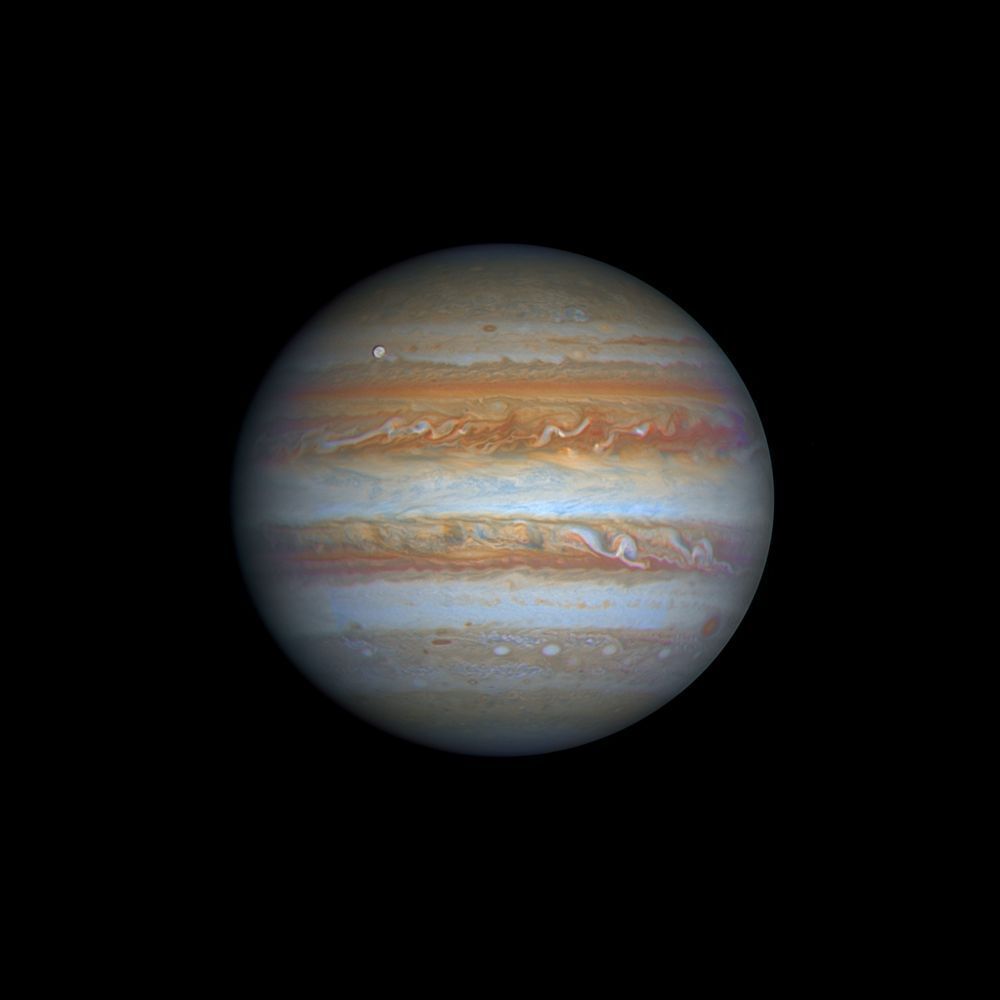
This image is a true-color, high-resolution composite of Jupiter during the transit of its Galilean moon Europa on 2017-02-01. The source data come from the Hubble Legacy Archive: individual monochrome frames captured through multiple filters spanning red to near-ultraviolet. I compensated for Jupiter’s fast ~9.9-hour rotation and Europa’s orbital motion, registered the frames precisely, and blended them into an accurate visible-light representation.
The result shows Jupiter’s layered cloud belts and turbulent storm lanes in natural hues, with Europa appearing as a distinct, bright disk projected on the planet’s face. The snapshot captures a dynamic moment of planetary geometry and highlights both atmospheric detail and satellite scale.
Encyclopedic note:
Europa is ~3,100 km across and completes an orbit around Jupiter every ~3.55 days. Its ice-covered surface and likely subsurface ocean make it a focus of planetary science and future missions such as Europa Clipper. Hubble observations like these help track cloud dynamics and timing of satellite transits.
-
Europa diameter ≈ 3,121 km; orbits Jupiter in ~3.55 days.
-
Jupiter rotates in about 9.9 hours, requiring rotation compensation when combining time-separated frames.
-
Hubble archival filter sequences (red to near-UV) recombined to approximate true-color visible images.