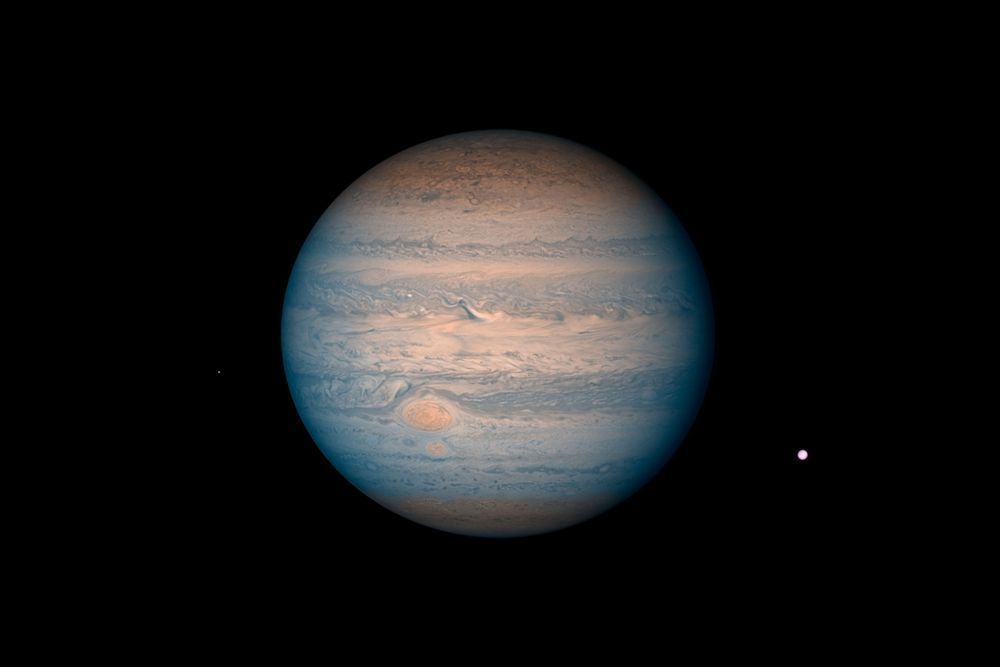
"Jupiter & Moons" is an astrophotograph created from Hubble Space Telescope WFC3 observations taken on September 19–20, 2012 and released via the Hubble Legacy Archive. This false‑color composite combines infrared and ultraviolet channels: the infrared channel sharpens cloud detail and horizontal banding, while the ultraviolet penetrates higher atmospheric layers and enhances polar structure. The image prominently shows Jupiter’s zonal cloud bands and the iconic Great Red Spot; the volcanic moon Io appears as a small bright globe and the faint inner moon Metis is visible near the planet’s limb.
This piece is a scientific image presented with aesthetic intent—an authentic astrophotographic record rather than a painting or illustrative rendering. The processing emphasizes natural structure revealed by the original wavelengths while maintaining fidelity to the source data. The photograph conveys scale and movement: Jupiter’s turbulent atmosphere, long‑lived anticyclone activity, and the contrasting scale of nearby moons.
Encyclopedic note: Jupiter’s Great Red Spot is an anticyclonic storm larger than Earth that has been observed for centuries. Io is the most volcanically active body in the solar system due to tidal heating from Jupiter, and Metis is one of Jupiter’s smallest inner moons, orbiting close to the planet inside the ring region. The Wide Field Camera 3 (WFC3) was installed on Hubble in 2009 and remains one of its primary imaging instruments. Source: Hubble Legacy Archive (WFC3 datasets, Sept 2012).