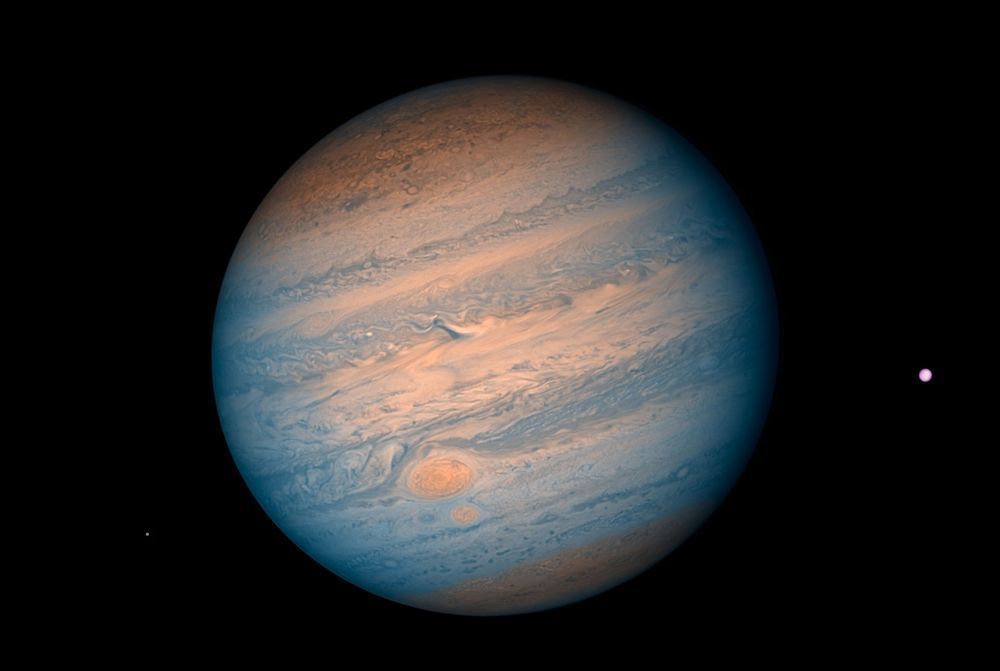
This piece is an astrophotographic composite derived from Hubble Space Telescope Wide Field Camera 3 infrared and ultraviolet observations taken September 19–20, 2012. Combining IR and UV channels produces a false-color view that emphasizes fine-scale cloud structure, revealing sharper wave patterns in the bands and deeper atmospheric contrasts around the poles. The Great Red Spot appears as a prominent, textured vortex; this storm has been observed for centuries and spans roughly the diameter of Earth. The image also captures the volcanic moon Io (visible as a small, bright disc) and the much tinier inner moon Metis near the limb.
Presented as a high-resolution photographic print, this work sits at the intersection of scientific imaging and fine-art presentation. It preserves the original observational provenance — Hubble WFC3 — while allowing the photographer’s processing choices to make atmospheric detail, contrasts, and composition accessible to a gallery or living space. The false-color rendering is intentional: infrared highlights thermal and cloud layering detail, while ultraviolet accentuates haze and polar features, together producing a visually rich and informative portrait of Jupiter’s dynamic atmosphere.
Trivia: Metis is one of Jupiter’s smallest moons (mean radius ~21 km) and Io’s diameter is ~3,642 km; the Great Red Spot has been tracked for centuries and historically measured at roughly 1–1.5 Earth diameters.
This piece is ideal for enthusiasts of planetary science, telescope imaging, and contemporary astrophotography.
-
Instrument: Hubble Space Telescope — Wide Field Camera 3 (WFC3).
-
Observation dates: September 19–20, 2012.
-
Great Red Spot: long-lived anticyclonic storm historically around ~1–1.5 Earth diameters (size varies).
-
Io: diameter ≈ 3,642 km, the most volcanically active body in the solar system.
-
Metis: innermost known moon of Jupiter, mean radius ≈ 21 km.