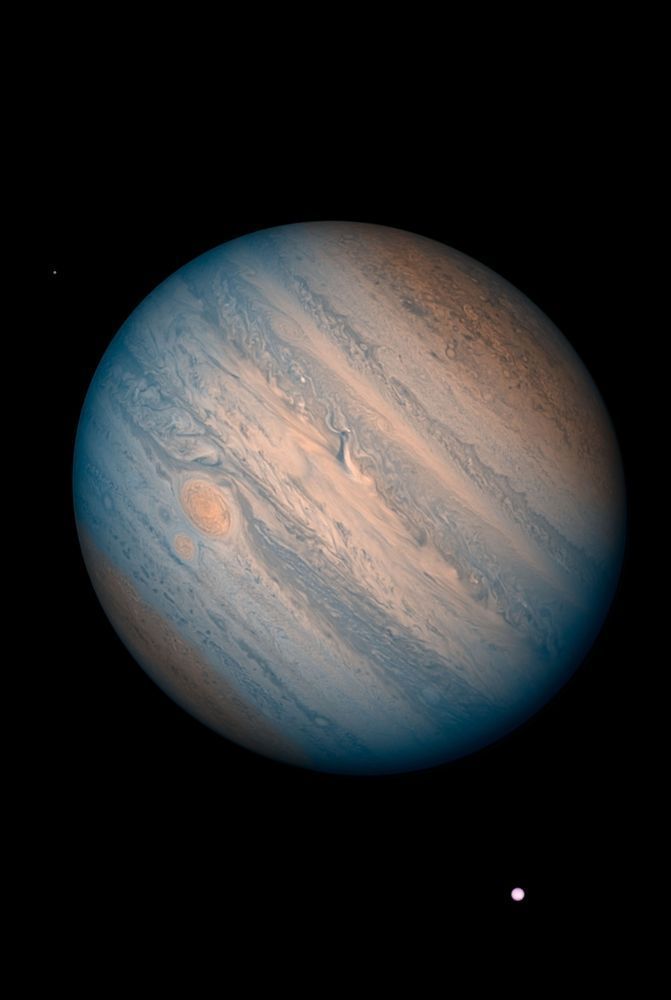
This image is an astrophotographic composite derived from Hubble Space Telescope Wide Field Camera 3 (WFC3) observations taken on September 19–20, 2012 and released through the Hubble Legacy Archive. It is a false‑color render that combines infrared and ultraviolet channels to emphasize different atmospheric depths and structures: infrared data sharpen cloud contrasts and reveal deeper layers, while ultraviolet highlights high-altitude hazes and polar features. The result is a crisp, revealing view of Jupiter’s dynamic belts, zones, and prominent storm ovals.
Visible in the frame are two of Jupiter’s companions: Io, the volcanically active moon, and Metis, a very small inner moon. Io appears as a bright point near the planet; Metis is the faint dot closer to the limb. The composition captures the turbulence and banding that define Jupiter’s weather system and offers both aesthetic presence and scientific context — useful for collectors, educators, and anyone who appreciates accurate space imagery.
Encyclopedic notes included with this piece: Jupiter is roughly 11 times wider than Earth; WFC3 has been a primary Hubble instrument since its installation in 2009; infrared and ultraviolet observations probe different atmospheric layers, enabling studies of deep cloud structure and polar chemistry. This print is presented as an astrophotograph — not a painting — reflecting data-driven imaging and careful processing to reveal genuine planetary detail.