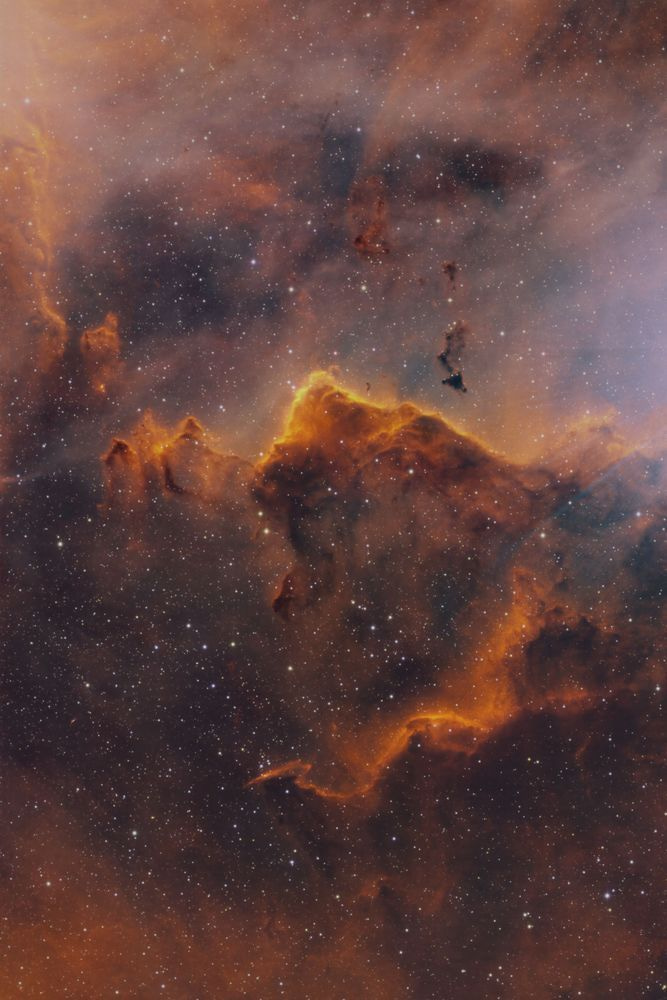
IC 2944 Running Chicken Nebula Close-Up looks into a star-forming region in the southern constellation Centaurus. Thousands of stars scatter across clouds of glowing gas in amber, rose, and smoky blue. Dark shapes of interstellar dust interrupt the brighter nebular edges, adding contrast and a sense of depth to the field.
This astrophotograph was captured over several hours using narrowband filters and mapped in the Hubble palette, also known as SHO. In this color-assignment method, sulfur-II data is shown as red, hydrogen-alpha as green, and oxygen-III as blue. The resulting hues are not a direct representation of what the nebula would look like to the unaided eye; instead, they help reveal distinctions in the gases that make up the image.
IC 2944 is an emission nebula associated with the young stars around Lambda Centauri. It is widely known by the nickname “Running Chicken Nebula,” inspired by shapes observers have imagined in its glowing clouds. The region is also famous for Thackeray’s Globules: dense, dark clumps of gas and dust seen in silhouette against the nebular light. These globules are a notable piece of astronomy trivia because they are sites of investigation into how stars form and how radiation from nearby stars affects such clouds.
Made for viewers drawn to deep-sky photography, this close-up pairs scientific subject matter with a striking, richly textured view of the cosmos.