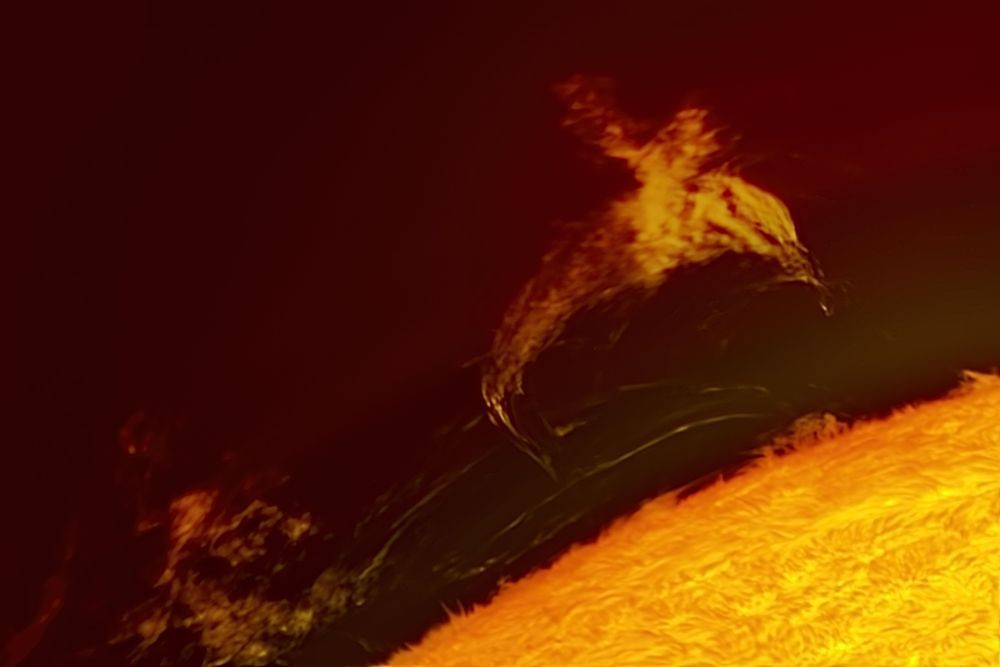
This astrophotograph documents a fiery solar prominence observed on 2025-03-24. Rendered in hydrogen‑alpha light, the image isolates chromospheric emission to reveal dense, cool plasma suspended above the solar surface by magnetic fields. The prominence rises in a curved loop, its leading edge shaped evocatively like a hummingbird, while tangled thread‑like structures trace magnetic field lines and motion within the plasma.
The contrast between the luminous prominence and the near‑black background enhances the sense of scale and energy. Though compact in the frame, such prominences can extend tens of thousands of kilometers—orders of magnitude larger than Earth—and contain material at temperatures around 10,000 K, compared with the million‑degree corona that surrounds them. This piece highlights both aesthetics and science: it is visually striking and also a clear demonstration of magnetic activity on our nearest star.
Printed or displayed at large scale, the image makes an educational and decorative statement—suitable for observatories, science centers, home offices, and modern interiors. Provenance: captured by an experienced astrophotographer using hydrogen‑alpha techniques (date recorded 2025-03-24). Framing and print options are available on request.
Encyclopedic trivia:
-
Solar prominences are composed mostly of hydrogen and can remain stable for days to weeks.
-
When a prominence erupts, it can become part of a coronal mass ejection (CME), potentially affecting space weather.
-
Hydrogen‑alpha (656.28 nm) imaging isolates chromospheric features and is a standard method for photographing prominences.