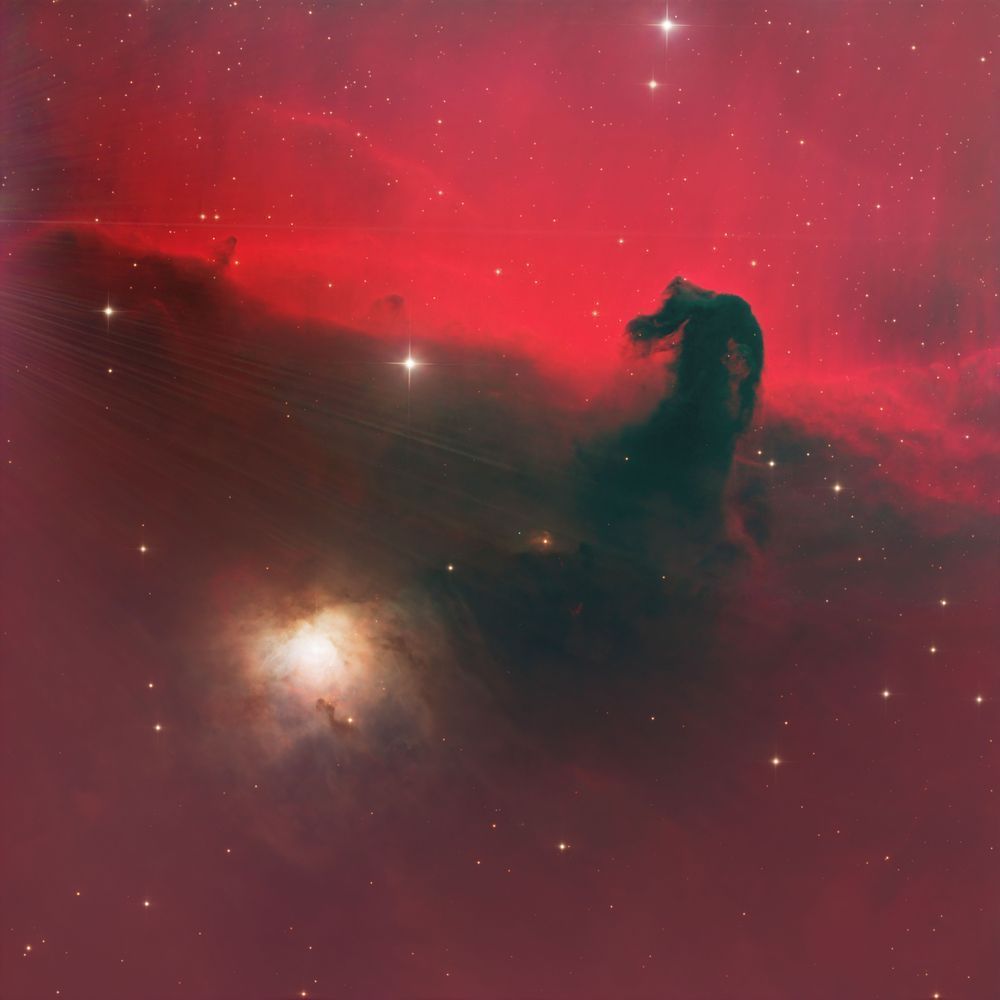
This photograph captures the iconic Horsehead Nebula (Barnard 33) as it sits carved into the bright hydrogen emission of IC 434 in the constellation Orion. The nebula appears as a dark, horse-shaped silhouette created by dense molecular dust blocking the glowing background gas. Beneath and to the left, the bright reflection nebula NGC 2023 adds contrast with its blue-tinted scattering of starlight.
The image emphasizes the contrast between the red H-alpha emission from ionized hydrogen and the cold, opaque dust that defines the Horsehead’s profile. The result is a study in scale and texture: faint background stars punctuate the field, while the Horsehead’s columnar form suggests dynamic processes of star formation in the Orion Molecular Cloud Complex. This is astrophotography — long exposures and careful processing were used to reveal detail in extremely faint structures.
Encyclopedic notes and trivia: the Horsehead Nebula lies roughly 1,300–1,500 light-years away and is located just south of Alnitak, one of Orion’s Belt stars. It’s cataloged as Barnard 33 within IC 434; NGC 2023 is the bright reflection nebula adjacent to it. (Note: NGC 2032 is a different object and not the Horsehead.) The red glow primarily originates from H-alpha emission; the silhouette is dense dust and molecular gas.