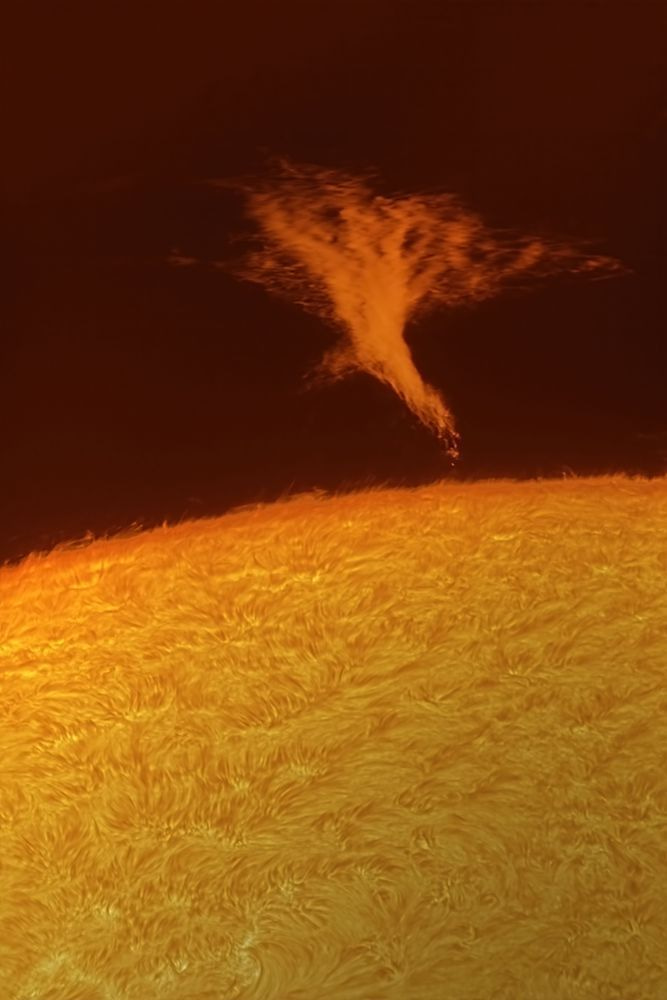
This image is a high-resolution hydrogen‑alpha astrophotograph of a solar prominence recorded on 2025-08-18. Seen at the Sun’s limb, the prominence erupts as a twisting column of cooler, dense plasma projecting into the million‑degree corona; its silhouette and branching structure evoke a desert acacia tree, inspiring the title. The foreground shows detailed chromospheric texture and granulation, offering contrast between the Sun’s surface patterns and the flowing prominence above.
Captured through a dedicated solar setup using an H‑alpha narrowband filter, this photograph emphasizes emission from hydrogen at 656.28 nm—ideal for revealing filaments, prominences, and chromospheric detail. Solar prominences are shaped and supported by magnetic fields; many extend tens of thousands of kilometers and can remain stable for days before erupting. This frame freezes one such moment of release and motion, translating solar physics into a visual narrative.
Encyclopedic trivia: solar prominences are cooler (~10,000 K) than the surrounding corona (millions of K). H‑alpha imaging is the standard technique for studying chromospheric features. Prominences can be larger than Earth and are central to space weather research because eruptions can accompany coronal mass ejections.
Encyclopedic notes & trivia (brief):
-
H‑alpha = 656.28 nm emission line of hydrogen; reveals chromospheric structures.
-
Prominences are magnetically suspended plasma; sizes commonly span tens of thousands of kilometers.
-
Observing prominences safely requires dedicated solar optics and narrowband filters to block harmful light.