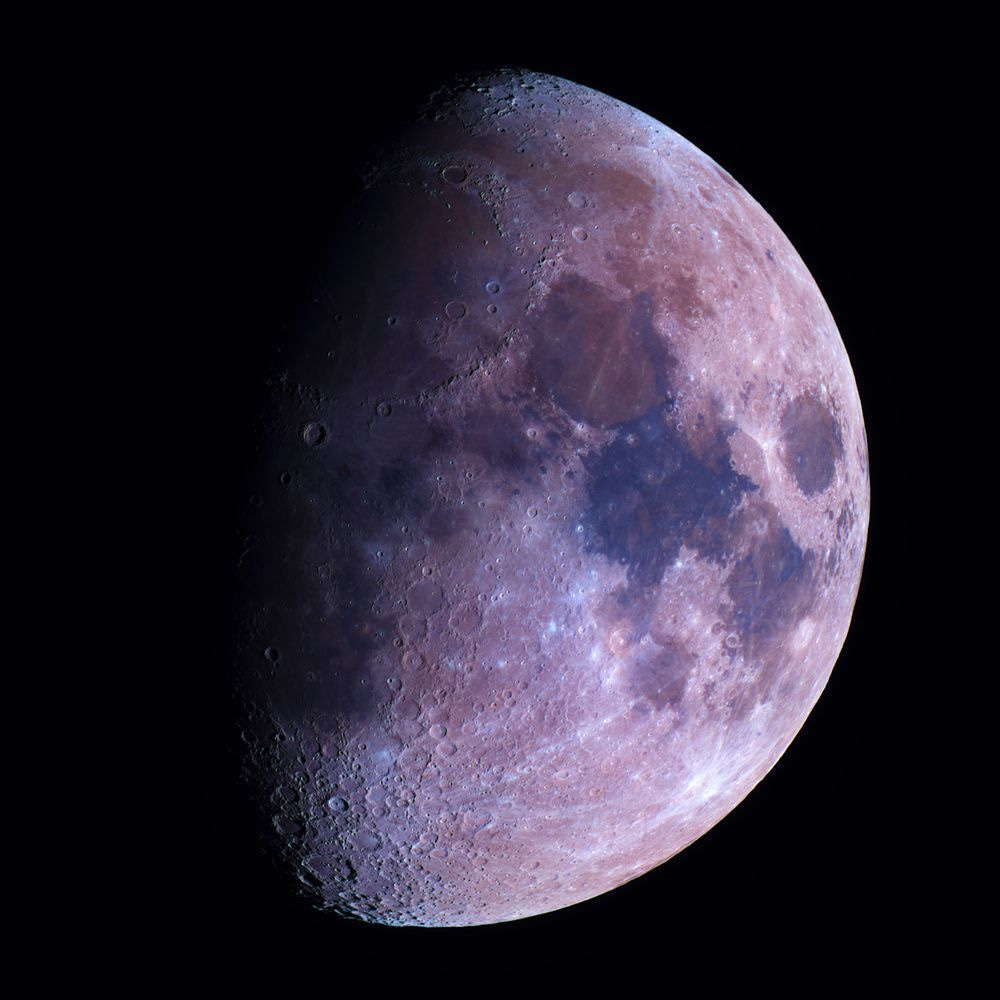
The Hidden Chemistry of the Moon is a fine-art astrophotography print that explores the Moon as both a familiar celestial neighbor and a geological record of deep time. Captured during a waxing gibbous phase, the image uses precision data-stacking to reduce atmospheric distortion and preserve detailed surface features. The angled sunlight along the terminator brings out crater rims, basin walls, ridges, and subtle variations in lunar topography.
The photograph’s color treatment is based on enhanced chromatic differences within the lunar surface. Deep blue and violet maria, including Mare Tranquillitatis, are associated with ancient basaltic lava plains and their relatively high titanium content. Mauve and rust-orange areas suggest variations in iron- and magnesium-rich lunar soils. Pink and pale-blue highlands distinguish the brighter, feldspar-rich anorthositic crust from the darker volcanic plains.
These colors are not visible to the unaided eye in this intensity. Instead, calibrated saturation reveals compositional differences recorded in the reflected sunlight, transforming telescopic data into a visually accessible study of lunar chemistry. The densely cratered highlands contrast with smoother maria formed by ancient volcanic eruptions, showing how impact events and internal geological activity shaped the Moon over billions of years.
The result bridges scientific documentation and contemporary photographic presentation. It invites close inspection of the Moon’s surface while offering a compelling focal point for interiors, observatories, offices, libraries, and collections devoted to astronomy or space exploration.
Lunar Context
The Moon’s dark maria are broad basaltic plains formed when ancient volcanic lava filled large impact basins. The brighter lunar highlands are dominated by anorthosite, a feldspar-rich rock that formed early in lunar history as lighter minerals floated within a global magma ocean. The terminator—the boundary between lunar day and night—creates long shadows that make surface relief especially visible. A waxing gibbous Moon is more than half illuminated and occurs between first quarter and full Moon. This particular photograph was taken on 2026-09-20 when the Moon was about 67% illuminated.