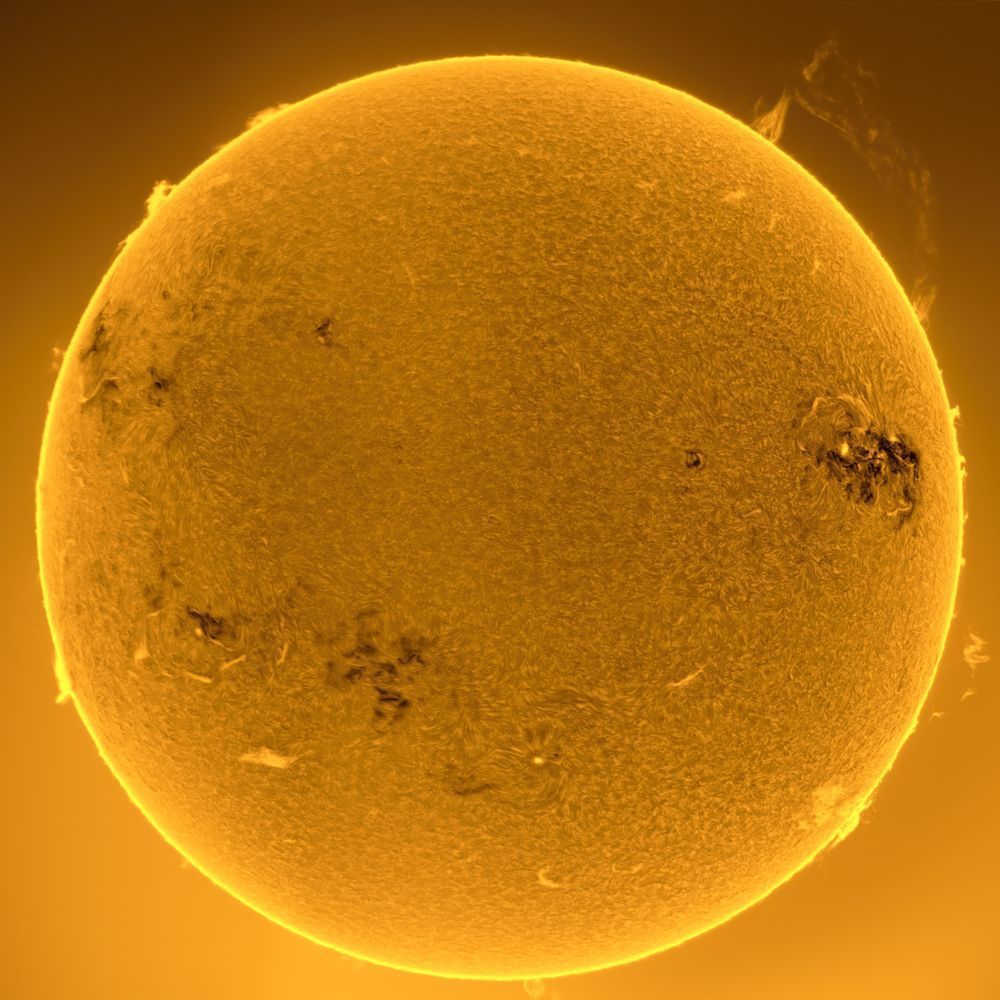
“The Living Sun” is a focused hydrogen‑alpha (Hα) solar photograph that exposes the Sun’s chromosphere and dramatic prominences with exceptional clarity. The image emphasizes surface texture across the disk — the mottled chromospheric fibrils, dark filaments, and active regions — while the limb shows bright prominences and looping plasma hugging the edge. Several sunspot groups and their surrounding magnetic activity are visible as darker, complex structures against the glowing chromosphere.
Captured specifically to highlight chromospheric detail, the photograph balances scientific fidelity and aesthetic composition. The frame isolates the solar disk to emphasize scale and motion: fine filaments trace magnetic field lines, while prominences erupt outward in sculpted arcs. This piece is intended for viewers who appreciate both the scientific story and the visual power of solar phenomena — ideal for classrooms, observatories, galleries, or private collections.
Encyclopedic note: The chromosphere is a thin layer above the photosphere where temperature rises and dynamic features like spicules and prominences form. Prominences can extend tens of thousands to hundreds of thousands of kilometers and trace the Sun’s magnetic field. Hα (656.28 nm) is the spectral line most commonly used to reveal chromospheric structures.
-
The chromosphere is typically a few thousand kilometers thick; above it lies the million-degree corona.
-
Prominences are anchored to the photosphere but can reach heights of tens to hundreds of thousands of kilometers.
-
Hα (hydrogen-alpha) at 656.28 nm is the standard spectral line used to study chromospheric features.