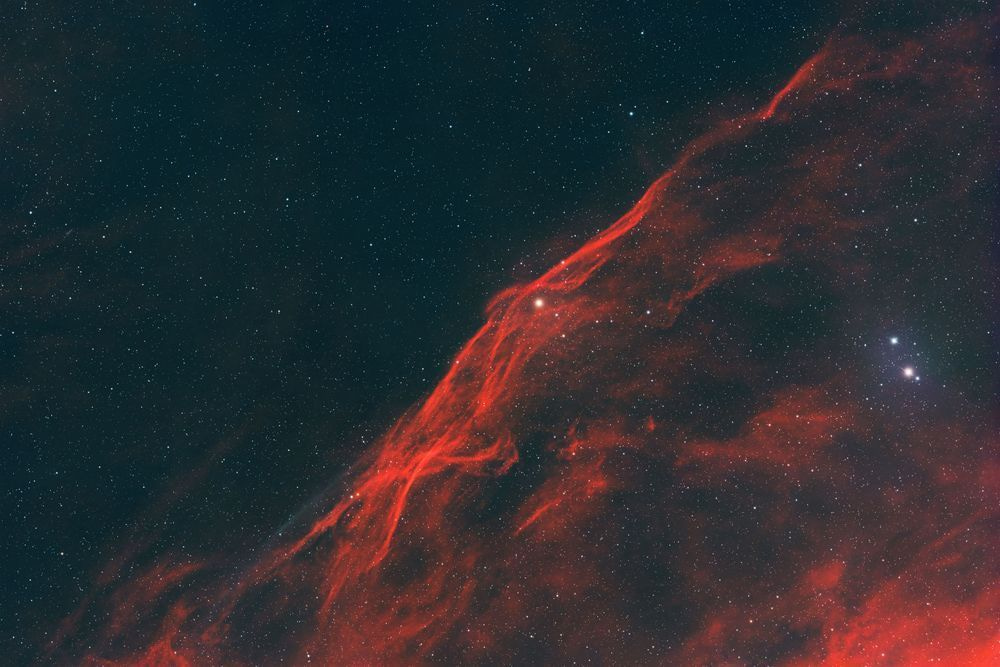
This is an original astrophotograph of LBN 331 in the constellation Cygnus, taken with a telescope from Lockwood Valley, California. The scene shows hydrogen‑rich molecular clouds ionized by the nearby star Omicron Cygni, emitting the characteristic red glow that traces filaments and wisps across the frame. The composition moves diagonally from lower right to upper left, creating a sense of motion and depth as faint stars and compact clusters peek through the nebulous veil.
Captured with careful long exposure and narrowband sensitivity to hydrogen emission, the image emphasizes structure over color saturation: delicate threads, brighter knots, and diffuse background haze are visible without artificial enhancement. This photograph connects observational technique to cosmic context—the LBN designation references the Lynds’ Bright Nebula catalog, a classic survey used by astronomers to map emission regions. Hydrogen‑alpha emission (around 656.3 nm) is the primary source of the red tones, while the teal background derives from contrast and sky conditions at the Lockwood Valley site.
Because this is astrophotography rather than a painted interpretation, it records real interstellar material shaped by stellar radiation and winds. The piece suits collectors who appreciate science‑grounded imagery, educators seeking illustrative photographs of emission nebulae, and anyone drawn to the dramatic textures of our galaxy’s star‑forming regions.
Encyclopedic Data & Trivia (concise):
-
LBN stands for Lynds’ Bright Nebula, a catalog compiled by Beverly T. Lynds in 1965–1982 that lists bright emission and reflection nebulae.
-
Hydrogen‑alpha emission (Hα, 656.3 nm) produces the red glow commonly seen in emission nebulae; it originates when ionized hydrogen recombines and emits light.
-
The Cygnus region of the Milky Way is rich in emission nebulae and dark dust lanes (the Cygnus Rift), making it a favorite target for astrophotographers.