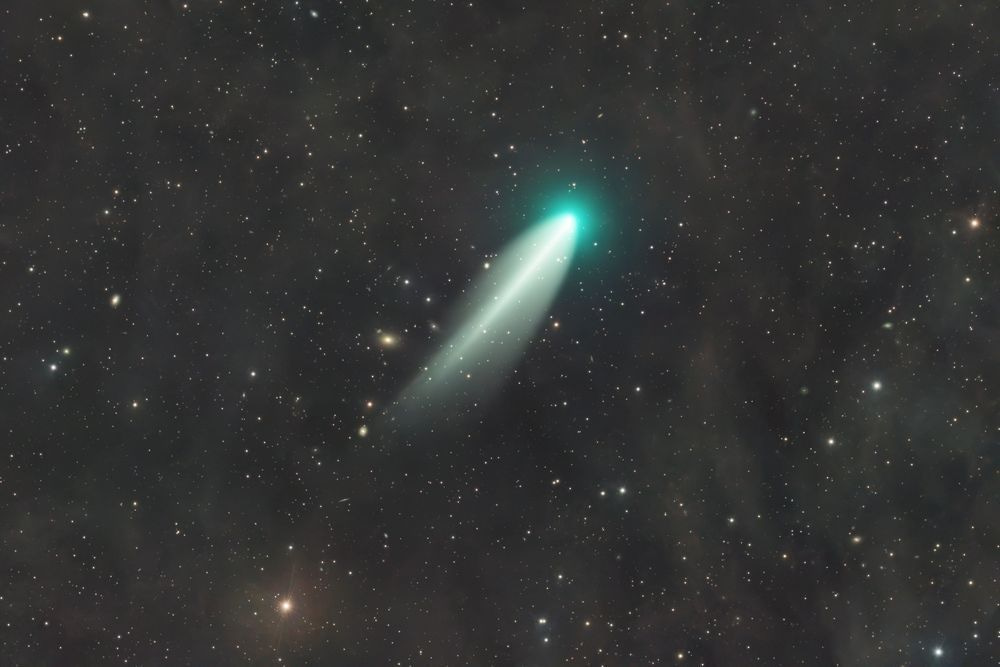
This photograph documents Comet 220P/McNaught as it moved through the constellation Cetus on 2026-08-16, displaying a vivid green coma and an elongated dust tail that fans outward into the starfield. The green hue near the nucleus results from gaseous emissions—commonly diatomic carbon (C2) and cyanogen (CN)—excited by sunlight and fluorescing in the coma. The tail shows the combined appearance of dust pushed into a broad fan and faint ion features shaped by the solar wind, creating a visible contrast between directed motion and serene background stillness.
Several small galaxies are visible in the background, giving scale and depth to the scene and emphasizing the comet’s passage through a richly populated patch of sky. This frame was produced with long-exposure astrophotography methods and image stacking to reveal faint structures while preserving the color of the comet’s coma and subtle background detail.
For collectors and astronomy enthusiasts, this piece offers both aesthetic calm and scientific interest. It works equally well as a focal statement in a living room or a study wall print for observatories and classrooms. Limited-format prints are available; archival-quality options and framing recommendations can be provided on request.
Note and trivia: The “P” in 220P denotes a periodic comet—one that returns on a predictable orbit. Robert H. McNaught is the discoverer (2024) associated with the name McNaught. The green color often seen in comets is a common spectroscopic signature caused by simple carbon molecules fluorescing in sunlight.