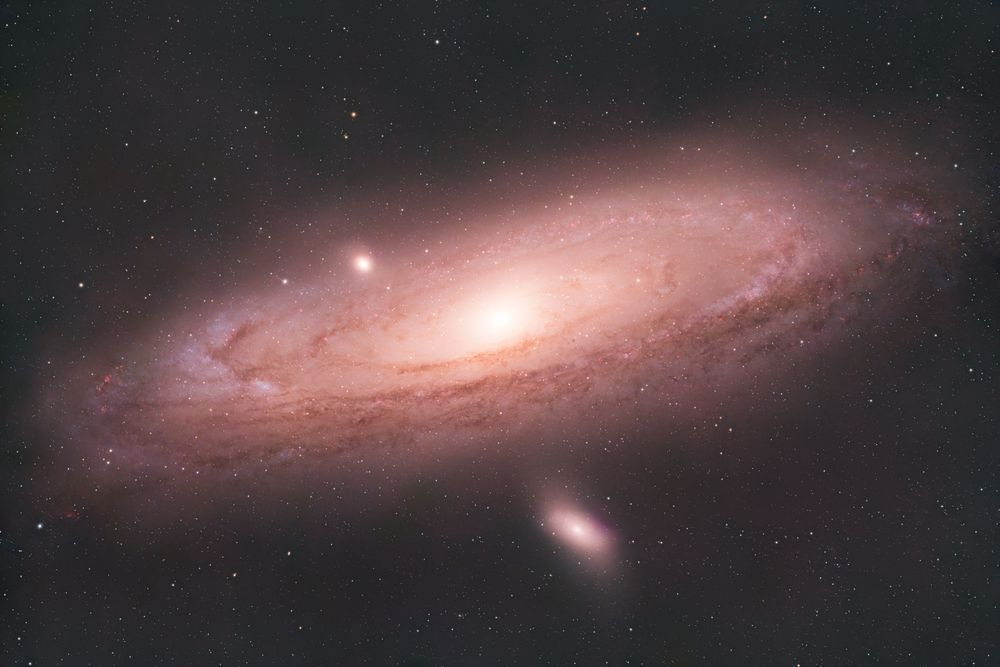
This image is a composite astrophotograph of the Andromeda Galaxy (M31) produced by merging broadband RGB frames with targeted hydrogen‑alpha (Hα) data to enhance emission regions. The integration of Hα reveals the pink H II regions where active star formation occurs, while the RGB channels retain natural color and clarity of M31’s dense central bulge, sweeping spiral arms, and intricate dust lanes. Two of Andromeda’s companions — the compact elliptical M32 and the elongated dwarf M110 — are visible near the main disk, adding context to the Local Group neighborhood.
Technically, combining Hα with RGB boosts contrast in faint emission without sacrificing the rich starfield or the warm tones of the galactic core. The composition emphasizes the galaxy’s inclination, allowing the viewer to appreciate both global structure and localized nebular detail. This photograph is intended for collectors, educators, and anyone fascinated by extragalactic structure; printed large it reveals subtle filaments and dust that reward close viewing.
Encyclopedic note: Andromeda is the nearest large spiral galaxy to the Milky Way, roughly 2.5 million light‑years away, and spans about 200,000–220,000 light‑years across. It contains hundreds of billions to over a trillion stars and is predicted to merge with the Milky Way in several billion years, forming a single elliptical galaxy.
Additional Details
-
Distance: ~2.5 million light‑years from Earth.
-
Size: roughly 200,000–220,000 light‑years across.
-
Star count: recent estimates place Andromeda’s stellar population near ~1 trillion.
-
Future: Andromeda and the Milky Way are on a collision course, expected to merge in about 4–5 billion years.